



Table of Contents
- How Chiropractic Care for Nerve Pain Works
- Pinched Nerve Symptoms in Neck and Other Warning Signs
- When to See a Chiropractor for a Pinched Nerve
- Chiropractic Care for Sciatica: What the Evidence Shows
- Nerve Pain in Legs Relief: Exercises and Daily Habits
- Red Flags: When Nerve Pain Needs Urgent Medical Care
- What to Expect During Your First Chiropractic Evaluation
- Frequently Asked Questions
Last Updated: October 14, 2026
How Chiropractic Care for Nerve Pain Works
Chiropractic care for nerve pain is a drug-free approach that focuses on finding and correcting the underlying spinal problems that irritate nerves, rather than just masking the ache with medication. At Gateway Chiropractic, we look at the whole spine, not just the spot that hurts.
The idea is simple. Your spinal cord sends nerves out between the bones of your spine, called vertebrae. When those bones shift out of place or a disc bulges, they can press on a nerve root. That pressure causes tingling, numbness, or sharp, shooting pain.
A chiropractor uses precise adjustments to realign the spine. The goal is to take pressure off the nerve and restore normal joint mobility. Less pressure means less irritation. Over time, this can calm inflammation and help nerve function improve.
- Spinal alignment: moving vertebrae back into their proper position
- Pressure relief: reducing the squeeze on a pinched nerve
- Joint mobility: restoring movement so the spine stops compensating
- Inflammation control: easing the swelling around irritated nerves
This is not a one-visit fix. Corrective care takes time because the body has to heal.
MedlinePlus guide to chiropractic
Pinched Nerve Symptoms in Neck and Other Warning Signs
Pinched nerve symptoms in the neck often start as a stiff, achy feeling and then spread into the shoulder, arm, or hand. That spread is the tell. A pinched nerve does not stay put.
Watch for these signs:
- Tingling or a “pins and needles” feeling in the arm or fingers
- Numbness in the hand or forearm
- Weakness when gripping or lifting
- Radiating pain that travels down one arm
- Neck pain that gets worse when you turn your head
A pinched nerve in the low back can send the same signals down a leg. That is often called sciatica. The pain follows the path of the nerve, which is why it shoots instead of staying in one spot.
When to See a Chiropractor for a Pinched Nerve
A chiropractor for a pinched nerve is a good first stop when your symptoms are mild to moderate and have lasted more than a few days. Many people wait weeks hoping it will pass. It usually does not.
See a chiropractor if you have:
- Pain that limits your normal daily movement
- Tingling or numbness that comes and goes
- Symptoms after a fall, a car accident, or heavy lifting
- Pain that has not improved with rest or over-the-counter medicine
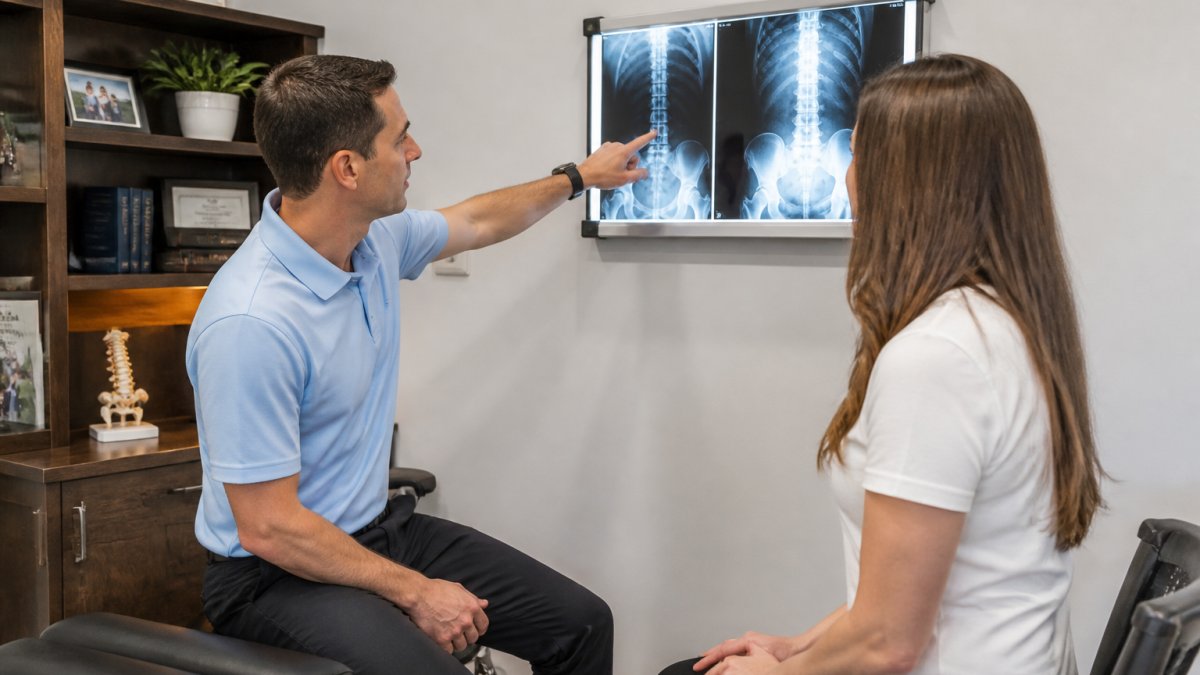
A chiropractor will examine you and, if needed, take X-rays to see what is really going on. At Gateway Chiropractic, we use spinal analysis and imaging to guide each adjustment instead of guessing.
If you have severe symptoms, see a medical doctor first. We explain those red flags below.
Chiropractic Care for Sciatica: What the Evidence Shows
Chiropractic care for sciatica gets mixed reviews, and honesty matters here. Some people get real relief. Others need a different approach. The evidence is promising but not perfect, and the quality of that evidence depends heavily on what is actually causing the nerve pain.
Sciatica happens when the sciatic nerve, the largest nerve in the body, gets compressed. It runs from your low back through your hip and down each leg. A herniated disc, spinal stenosis, or a shifted vertebra is often the cause.
Spinal nerve-root irritation versus peripheral neuropathy. These two look similar on the surface and are treated very differently.
- Nerve-root irritation (radiculopathy): the nerve is pinched where it exits the spine. Pain follows a specific dermatome pattern, often worsens with coughing, sneezing, sitting, or bending, and usually affects one side. This is the pattern chiropractic care is best positioned to help.
- Peripheral neuropathy: the nerve itself is damaged, often from diabetes, chemotherapy, alcohol use, vitamin B12 deficiency, or thyroid disease. Symptoms are typically symmetric, start in the feet and hands, and feel like burning, buzzing, or a stocking-glove numbness. Spinal adjustments do not reverse this kind of nerve damage.
A clinician sorts these apart with a focused history, a neurological exam (reflexes, muscle strength, sensation testing, straight-leg raise), and imaging when the picture is unclear. Blood work for blood sugar, B12, and thyroid function is common when peripheral neuropathy is suspected.
What research generally supports for radicular pain:
- Spinal manipulation can reduce low back pain and leg pain for some patients with disc-related sciatica
- Adjustments may ease pressure on the nerve root and improve short-term mobility
- Combining adjustments with exercise tends to work better than either alone
- Results are best in the first several weeks; outcomes vary widely by cause, age, and symptom duration
What the evidence does not promise: a cure for every case. A herniated disc that is badly torn, spinal stenosis that is advanced, or nerve damage from a metabolic cause may need medical care beyond adjustments. Chiropractic care works best as part of a plan, not as a stand-alone magic bullet.
Symptom relief is not the same as nerve recovery. Feeling better after an adjustment often reflects reduced muscle spasm, improved joint motion, and less mechanical irritation. It does not automatically mean the nerve has healed. Numbness and weakness can lag behind pain relief by weeks or months, and in some cases they do not fully resolve.
National Center for Complementary and Integrative Health on spinal manipulation
National Institute of Neurological Disorders and Stroke on peripheral neuropathy
Nerve Pain in Legs Relief: Exercises and Daily Habits
Nerve pain in legs relief comes from two things: taking pressure off the nerve and keeping the muscles around it strong. Daily habits matter as much as your visits.
Try these at home:
- Gentle stretching: a seated hamstring stretch and a figure-four stretch for the piriformis
- Nerve glides: slow, controlled leg movements that help the nerve slide freely
- Core work: planks and bird-dogs to support your low back
- Walking: short, frequent walks to keep blood flowing
Daily habits that help:
- Avoid sitting for long stretches. Stand and move every 30 minutes.
- Set up your chair so your feet rest flat and your back is supported.
- Sleep on your side with a pillow between your knees.
- Skip heavy lifting until symptoms calm down.
Red Flags: When Nerve Pain Needs Urgent Medical Care
Some nerve pain is a medical emergency, not a chiropractic case. Knowing the difference can protect you from serious harm.
Get urgent medical care if you have:
- Loss of bladder or bowel control
- Numbness in the groin or inner thigh area
- Sudden, severe weakness in one or both legs
- Nerve pain after a major accident or fall
- Fever, chills, or unexplained weight loss along with back pain
These signs can point to a condition called cauda equina syndrome, which needs emergency treatment. Do not wait. Do not try to adjust it yourself.
A good chiropractor will screen for these red flags during your first visit. If we see them, we send you to the right medical professional. That is part of doing this job responsibly.
MedlinePlus on cauda equina syndrome
What to Expect During Your First Chiropractic Evaluation
Your first visit is mostly about answers. A chiropractor will ask about your symptoms, your history, and what makes the pain worse or better. Then comes a physical and neurological exam. The goal is not to start adjusting immediately.
Step 1: History and symptom mapping. Expect detailed questions about where the pain starts, where it travels, what makes it worse, and how long it has been going on.
Step 2: Physical and neurological exam. This is where the differential gets sorted out.
- Range of motion and posture: checking how the spine moves and where it guards
- Reflex testing: diminished reflexes suggest nerve-root involvement
- Strength testing: specific weak muscle groups map to specific nerve roots
- Sensation testing: light touch and pinprick checks reveal which nerve fibers are affected
- Orthopedic tests: straight-leg raise, Spurling’s test, and similar maneuvers reproduce nerve irritation
Step 3: Imaging and lab work when needed. X-rays show alignment, joint spacing, and degenerative changes but do not show nerves. If a disc herniation or stenosis is suspected, an MRI is the better study.
Step 4: Safety screening before any adjustment. A responsible chiropractor screens for contraindications before the first adjustment. These include severe osteoporosis, spinal fracture, active infection, cancer in the spine, uncontrolled bleeding disorders, and significant disc herniation with progressive neurological loss.
Step 5: A written care plan with clear goals. You should leave the first visit knowing what was found, what the working diagnosis is, how many visits are recommended, and what improvement should look like. Ask these questions before agreeing to a plan:
- What is the specific diagnosis, and how was it determined?
- What objective measures will track progress (strength, reflex, range of motion)?
- How many visits, over what timeframe, before we reassess?
- What home exercises support the plan?
- At what point would you refer me to another provider?
|
Stage |
What Happens |
Typical Focus |
|---|---|---|
|
First visit |
History, exam, imaging, safety screen |
Find the cause and confirm it is safe to treat |
|
Early care |
Frequent adjustments plus home exercise |
Reduce pain and restore motion |
|
Corrective phase |
Adjustments plus strengthening |
Rebuild support around the spine |
|
Reassessment |
Repeat objective measures |
Decide whether to continue, modify, or refer |
|
Wellness phase |
Less frequent visits |
Maintain gains long-term |
Possible side effects and risks. Most people feel fine after an adjustment. A common pattern is mild soreness or stiffness for a day or two in the area that was treated.
How chiropractic care fits alongside other options. Chiropractic care is one conservative option among several. Physical therapy focuses on strengthening and movement retraining. Medical care may include anti-inflammatory medication, nerve-pain medication such as gabapentin, steroid injections, or, in serious cases, surgery.
You should feel informed, not rushed. Ask questions. A good clinic welcomes them.
Frequently Asked Questions
Can a chiropractor help with nerve pain?
Chiropractic care may help some types of nerve pain, particularly when the cause is spinal misalignment or joint restriction pressing on a nerve root. A chiropractor uses spinal adjustments and soft tissue work to reduce pressure and improve mobility. Results vary by cause and severity. A proper evaluation, sometimes with X-rays, determines whether chiropractic care is appropriate or whether you need a referral to another specialist.
What are the neurological symptoms of a pinched nerve in the neck?
Pinched nerve symptoms in the neck often include sharp or burning pain that radiates into the shoulder, arm, or hand. You may notice tingling, numbness, or weakness in the affected arm. Some people experience a pins-and-needles sensation or difficulty gripping objects. If symptoms include loss of coordination, severe weakness, or problems with bowel or bladder control, seek urgent medical care immediately.
Is a chiropractor a good option for sciatica?
Many people with sciatica find relief through chiropractic care, especially when the cause is a misaligned vertebra or tight muscles compressing the sciatic nerve. Treatment typically combines spinal adjustments, stretching, and strengthening exercises. However, sciatica from a severe disc herniation or spinal stenosis may require medical or surgical evaluation. A chiropractor can assess your situation and refer you if needed.
How can you relieve nerve pain in your legs?
Nerve pain in legs relief often starts with reducing pressure on the affected nerve. Gentle stretching, mobility exercises, and avoiding prolonged sitting can help. A chiropractor may use spinal adjustments to improve alignment and reduce nerve irritation. Ice or heat, depending on the stage of injury, can ease symptoms. If pain worsens or you lose feeling in your legs, see a medical professional promptly.
Nerve pain rarely fixes itself, and guessing at the cause can make things worse. At Gateway Chiropractic, we use advanced spinal analysis, precise adjustments guided by X-rays, and therapeutic exercise to address the root cause instead of just the symptom. Our drug-free corrective care is built for busy parents, athletes, and workers who want to move well and sleep better. Schedule Your Appointment with Gateway Chiropractic and take the first real step toward lasting relief.
