



Table of Contents
- Why Chiropractic Exercises Matter for Busy Parents
- What You’ll Need Before You Start
- Back Stretches for Parents: Daily Relief Routine
- Neck and Shoulder Stretches for Parents: Tension Relief
- Quick Posture Exercises at Home: Correct Your Form
- Mobility Exercises for Busy Parents: Short Routines That Fit Your Day
- Safety Guidelines and When to Stop
- How These Exercises Complement Chiropractic Care
- Frequently Asked Questions
Last Updated: October 19, 2026
Why Chiropractic Exercises Matter for Busy Parents
Chiropractic exercises for busy parents are essential tools for managing the physical strain of parenting. Juggling work, kids, and household responsibilities takes a toll: your neck tightens from hunching over while feeding infants, your back aches from lifting toddlers and carrying car seats, and your shoulders creep up from stress.
At Gateway Chiropractic, we work with parents every day who feel trapped by this cycle.
These exercises do more than ease discomfort. They improve spinal mobility, strengthen the muscles that support your spine, and help you move better.
The best part? You don’t need a gym, special equipment, or an hour of free time. These routines fit into the life you already have.
What You’ll Need Before You Start
You need almost nothing to begin chiropractic exercises for busy parents. They’re designed to work in real life, not in a perfect studio setting.
What to gather:
- A yoga mat or towel (optional but helpful for comfort)
- A quiet space about 6 feet by 3 feet
- 5 to 15 minutes of uninterrupted time
- Comfortable clothing you can move in
What you don’t need:
- Expensive equipment
- A gym membership
- Special shoes or gear
- A trainer or instructor
If you have young children at home, do these exercises during nap time, early morning, or while they play nearby. The key is consistency, not perfection.
Before starting any new exercise routine, check with your chiropractor or doctor, especially if you have existing back pain, neck issues, or recent injuries. These exercises are gentle and complement chiropractic care, but your provider should know what you’re doing.
Back Stretches for Parents: Daily Relief Routine
Back stretches for parents target the areas that take the most punishment: your lower back, mid-back, and the muscles along your spine. These three stretches form the foundation of daily relief and take about 5 minutes.
Cat-Cow Stretch
The cat-cow stretch is one of the most effective moves for spinal mobility. It gently flexes and extends your entire spine, releasing tension and improving flexibility.
How to do it:
- Get on your hands and knees on a mat or carpet
- Keep your hands directly under your shoulders and knees under your hips
- Start in the “cow” position: drop your belly, lift your chest and head, and look slightly upward
- Hold for 2 seconds
- Move into the “cat” position: round your spine, tuck your chin to your chest, and draw your belly in
- Hold for 2 seconds
- Move slowly between positions for 1 minute, breathing smoothly
Why it works: This stretch mobilizes each vertebra individually, warming up muscles and joints, increasing blood flow, and helping you move more freely.
Common mistake: Moving too fast. This stretch works best when you move slowly and deliberately. Rushing through it reduces the benefit.
Seated Spinal Flexion
Seated spinal flexion targets your lower back and the muscles along your spine, especially helpful if you spend time sitting, which most busy parents do.
How to do it:
- Sit on the floor with your legs extended in front of you
- Keep your feet together and your back straight
- Slowly bend forward from your hips, letting your head and arms hang naturally
- Don’t force yourself down or bounce
- Hold this position for 30 seconds while breathing deeply
- Slowly roll back up to sitting position
Why it works: This stretch lengthens the muscles along your entire spine, releases lower back tension, and improves hamstring flexibility, which affects how your lower back functions.
When to skip it: If you have acute lower back pain or a recent injury, check with your chiropractor before doing this stretch.
Spinal Twists for Torso Mobility
Spinal twists for torso mobility improve rotation and release tension on both sides of your spine.
How to do it:
- Sit on the floor with your legs extended
- Bend your right knee and cross your right foot over your left leg
- Place your right hand behind you for support
- Wrap your left arm around your right knee
- Gently twist your torso to the right, looking over your right shoulder
- Hold for 20 to 30 seconds
- Return to center and repeat on the other side
Why it works: This stretch improves rotational range of motion and releases muscles that tighten from daily activities. Better spinal mobility means less stiffness and more freedom of movement.
Breathing tip: Exhale as you twist deeper. Don’t force the stretch. Gentle, gradual movement is more effective than aggressive stretching.
Neck and Shoulder Stretches for Parents: Tension Relief
Your neck and shoulders hold stress like nowhere else. Parenting, work, and screen time all contribute to tightness here. These two stretches provide relief and prevent the forward head posture that develops from looking down at kids and devices.
Neck Stretches
Neck stretches for parents address the most common complaint: tension and stiffness that radiates down into your shoulders.
How to do it:
- Sit up straight in a chair
- Slowly tilt your right ear toward your right shoulder
- Hold for 15 to 20 seconds
- Return to center
- Repeat on the left side
- Then slowly turn your head to look over your right shoulder, hold for 15 seconds
- Return to center and repeat on the left
Why it works: Gentle neck stretches release muscles that tighten from stress and poor posture, improving range of motion and reducing stiffness.
Important: Never bounce or force your neck into a stretch. Move slowly and stop if you feel sharp pain. Gentle tension is good. Pain is a signal to stop.
Shoulder Rolls and Release
Shoulder rolls and release is the simplest stretch but one of the most effective for daily tension relief.
How to do it:
- Stand with your arms at your sides
- Slowly roll both shoulders backward 10 times, making big circles
- Roll both shoulders forward 10 times
- Then lift both shoulders up toward your ears and hold for 2 seconds
- Release and let them drop
- Repeat the lift and drop 10 times
Why it works: This movement releases muscles that tighten from carrying tension, improves circulation, and helps you notice when your shoulders creep up toward your ears during the day. (Source: the importance of regular physical activity)
Do this often: Unlike other stretches, you can do shoulder rolls throughout your day whenever tension builds, while standing in the kitchen, waiting for your kids, or between work tasks.
Quick Posture Exercises at Home: Correct Your Form
Poor posture creates problems that build over time: your neck pulls forward, your shoulders round, your lower back flattens. Correcting your posture now prevents bigger problems later.
Wall posture check:
- Stand with your back against a wall
- Your heels should be about 6 inches from the wall
- Your head, shoulders, and buttocks should touch the wall
- There should be a small gap between your lower back and the wall (about the thickness of your hand)
- Hold this position for 30 seconds
- Step away and try to maintain this posture as you move
This teaches your body what good posture feels like. Practice daily until proper alignment becomes automatic.
Chin tucks:
- Sit or stand with good posture
- Look straight ahead
- Gently tuck your chin back, creating a double chin (this feels strange but is correct)
- Hold for 2 seconds
- Release and repeat 10 times
Chin tucks strengthen the muscles that support your neck and counteract forward head posture. Do these several times throughout your day.
Mobility Exercises for Busy Parents: Short Routines That Fit Your Day
The real challenge isn’t knowing which exercises to do, it’s fitting them into your schedule. These two short routines solve that.
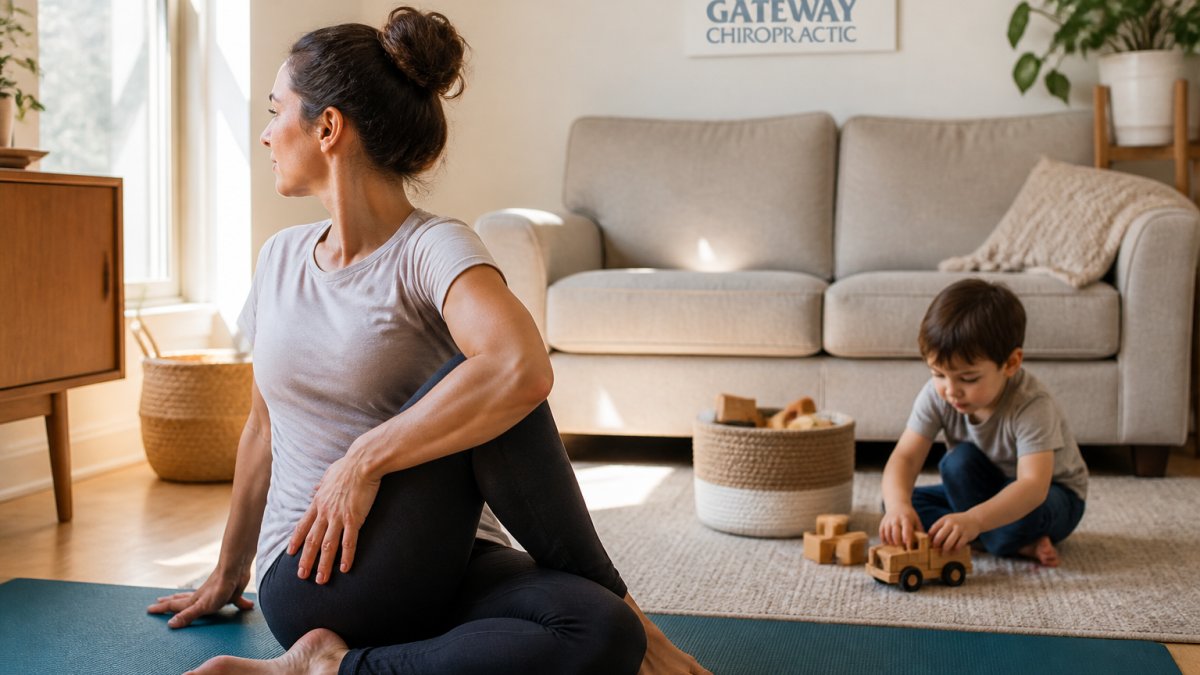
5-Minute Morning Routine
Do this routine right after you wake up, before the chaos starts. It prepares your body for the day and sets a positive tone.
The sequence:
- Cat-cow stretch: 1 minute
- Neck stretches (both sides): 1 minute
- Shoulder rolls: 30 seconds
- Spinal twists (both sides): 1 minute
- Wall posture check: 30 seconds
Why morning works: Your body is stiff after sleep. This routine wakes up your spine, improves mobility, and helps you start the day with better posture.
Make it a habit: Do this routine at the same time every morning. Consistency matters more than intensity.
10-Minute Evening Routine
This longer routine works well after kids are in bed or during a quiet moment in the evening. It’s deeper than the morning routine and helps you wind down.
The sequence:
- Cat-cow stretch: 2 minutes
- Seated spinal flexion: 1 minute
- Neck stretches (both sides): 1 minute
- Shoulder rolls and release: 1 minute
- Spinal twists (both sides): 2 minutes
- Wall posture check: 1 minute
- Breathing: 1 minute (sit quietly and breathe deeply)
Why evening works: This routine helps your body relax after a busy day. Better flexibility and reduced tension mean better sleep.
Progression: Start with the 5-minute routine for a week or two. Once that feels easy, add the 10-minute routine 3 to 4 times per week.
Safety Guidelines and When to Stop
These exercises are gentle, but you need to know when to stop and when to seek help.
Stop immediately if you feel:
- Sharp pain (not to be confused with gentle stretching sensation)
- Shooting pain down your arm or leg
- Dizziness or lightheadedness
- Numbness or tingling that doesn’t go away
- Pain that gets worse instead of better
When to check with your chiropractor:
- If you have existing back or neck problems
- If you’ve had recent injuries or surgery
- If pain doesn’t improve after 2 weeks of consistent exercise
- If you’re unsure whether an exercise is right for your situation Professional guidance ensures that your recovery remains safe and effective while you explore various methods to relieve back pain within the comfort of your own home.
General safety rules:
- Never bounce or force stretches
- Move slowly and deliberately
- Breathe smoothly throughout each exercise
- Don’t exercise through pain
- If something doesn’t feel right, skip it and ask your healthcare provider
These exercises complement professional chiropractic care; they are not replacements for proper diagnosis and treatment.
How These Exercises Complement Chiropractic Care
Chiropractic exercises for busy parents work best alongside professional chiropractic treatment. Here’s why the combination matters.
Your chiropractor identifies the root cause of your pain and uses precise adjustments to correct spinal misalignments.
According to research from the American Chiropractic Association, patients who combine chiropractic adjustments with therapeutic exercises see better long-term results than those who rely on adjustments alone.
Gateway Chiropractic uses therapeutic exercise as a core part of our approach.
Think of it this way: your chiropractor gets your spine working properly.
Busy parents deserve to feel good. Chronic pain and stiffness don’t have to be part of parenting.
Frequently Asked Questions
Are chiropractic exercises safe to do at home without professional guidance?
Home exercises based on chiropractic principles are generally safe when you follow proper form and listen to your body. Start slowly and stop immediately if you feel sharp pain, numbness, or tingling. These exercises complement professional chiropractic care, they are not a replacement for it. If you have a history of spine injury or ongoing pain, consult a chiropractor before beginning any new routine to ensure the exercises suit your specific condition.
How often should busy parents do chiropractic exercises for best results?
Consistency matters more than duration. Aim for gentle movement breaks daily, even if just 5-10 minutes. Many parents see improved flexibility, reduced stiffness, and better posture within 2-3 weeks of regular practice. If you’re managing chronic back or neck discomfort, daily gentle stretching combined with periodic professional chiropractic adjustments tends to produce the best long-term results for spinal health and mobility.
Can I modify these exercises if I’m postpartum or recovering from injury?
Yes, modifications are important during recovery. Postpartum parents should avoid high-impact movements and heavy twisting for at least 6-8 weeks. Start with gentle cat-cow stretches and light neck rolls, then gradually add range-of-motion work as comfort improves. If you’re recovering from a specific injury, ask your chiropractor which exercises are appropriate for your stage of healing. Personalized guidance ensures you strengthen without re-injury.
How do these exercises help if I’ve tried other treatments without success?
Chiropractic exercises address root causes of pain by improving spinal mobility, correcting posture, and reducing muscle tension, not just masking symptoms. When combined with professional chiropractic adjustments guided by advanced technology and spinal analysis, these exercises support lasting change in how your spine functions. Many parents find that consistent home practice between adjustments accelerates recovery and prevents pain from returning.
